Before you read. This guide is educational and does not replace your Medication Guide, pharmacist, prescriber, diagnosis, or emergency care. It does not say which medicine you should take, and it cannot: these two products are approved for different conditions, and matching a medicine to a person is your prescriber's job. Do not start, stop, switch, or change the dose of anything based on this page.
Quick answer
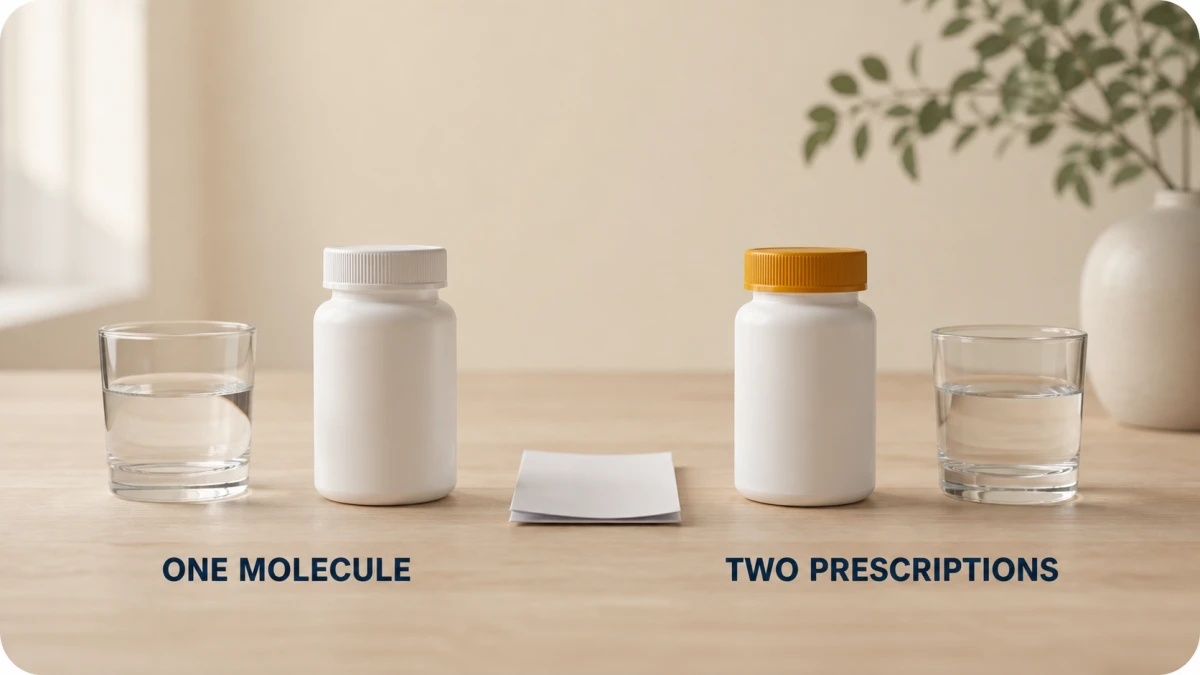
Rybelsus and the Wegovy pill contain the same active ingredient — semaglutide — in a once-daily tablet built with the same absorption enhancer, taken under the same rules: empty stomach, morning, up to 4 ounces of plain water, then a 30-minute wait. What differs is the prescription. Rybelsus is approved for adults with type 2 diabetes, in strengths of 3, 7, and 14 mg. Wegovy tablets are approved for chronic weight management and for cardiovascular risk reduction in adults with obesity or overweight, in strengths of 1.5, 4, 9, and 25 mg. Same molecule, different indications, different dose ladders — and the labels do not treat them as interchangeable.
Open Takely in your browserIs Rybelsus the same as Wegovy?
Chemically, the active ingredient is identical: semaglutide, a GLP-1 receptor agonist. Both tablets also share the trick that makes oral semaglutide possible at all — co-formulation with salcaprozate sodium (SNAC), the absorption enhancer that lets a fragile peptide survive the stomach long enough to be absorbed there.
As products, they are not the same, and the difference is the part that matters at the pharmacy counter:
| Rybelsus | Wegovy tablets | |
|---|---|---|
| Active ingredient | Semaglutide | Semaglutide |
| Form | Once-daily tablet with SNAC | Once-daily tablet with SNAC |
| Approved for | Improving glycemic control in adults with type 2 diabetes, alongside diet and exercise; the oral semaglutide diabetes label also covers reducing the risk of major adverse cardiovascular events in adults with type 2 diabetes at high risk | Reducing excess body weight and maintaining weight reduction long term in adults with obesity, or overweight with at least one weight-related condition; reducing the risk of major adverse cardiovascular events in adults with established cardiovascular disease and obesity or overweight |
| Strengths | 3, 7, 14 mg | 1.5, 4, 9, 25 mg |
| Weight-management indication | No | Yes |
| Type 2 diabetes indication | Yes | No |
| Boxed warning | Thyroid C-cell tumors | Thyroid C-cell tumors |
| Contraindications | Personal or family history of medullary thyroid carcinoma; MEN 2; serious hypersensitivity to semaglutide | The same |
So the honest one-line answer: same drug, different prescriptions. Which one belongs on your prescription depends on what it is being prescribed for — and that is a clinical decision, not a brand preference.
Where the confusion comes from
Semaglutide is one molecule sold under three brand names, and since the oral forms arrived, every brand has more than one form. It is genuinely confusing, so here is the whole map in one table:
| Brand | Form | Approved for |
|---|---|---|
| Rybelsus | Daily tablet (3, 7, 14 mg) | Type 2 diabetes |
| Ozempic | Weekly injection | Type 2 diabetes |
| Ozempic tablets | Daily tablet (1.5, 4, 9 mg) | Type 2 diabetes |
| Wegovy | Weekly injection | Weight management; cardiovascular risk reduction; plus indications the tablet does not have |
| Wegovy tablets | Daily tablet (1.5, 4, 9, 25 mg) | Weight management; cardiovascular risk reduction |
Two details from that table repay a second look. First, Rybelsus and Ozempic tablets are both oral semaglutide for type 2 diabetes — they now share a single FDA label — yet their strengths differ because the newer tablet strengths were calibrated differently. Second, Wegovy tablets and Ozempic tablets share three strengths (1.5, 4, 9 mg) but part ways at the top: the weight-management ladder continues to a 25 mg maintenance dose, while the diabetes ladder tops out at 9 mg on that label.
If the comparison you actually meant is the Wegovy pill against the Wegovy pen, that is its own question with its own trade-offs — we cover it in the Wegovy pill against the Wegovy pen. And if you want all four oral GLP-1 brands side by side, see the four oral GLP-1 brands compared.
The dose ladders, side by side
Both products titrate in 30-day steps, for the same reason all GLP-1 medicines start low: to reduce the risk of gastrointestinal side effects. This table is for recognising where you are, not for adjusting anything.
| Days | Rybelsus | Wegovy tablets |
|---|---|---|
| 1–30 | 3 mg | 1.5 mg |
| 31–60 | 7 mg | 4 mg |
| 61–90 | 7 mg continued, or 14 mg if more glycemic control is needed | 9 mg |
| 91 onward | 7 or 14 mg | 25 mg (maintenance) |
Note what the left column does and the right column does not: Rybelsus settles at a maintenance dose of 7 mg, with 14 mg as an option if needed, and its label states plainly that the starting dose is for treatment initiation and is not effective for glycemic control. The Wegovy ladder climbs through all four steps to a single 25 mg maintenance dose. The milligram numbers are not comparable across the columns as "strength rankings" — they belong to different clinical programmes answering different questions.
Can you take both, or swap one for the other?
No and no — not on your own initiative.
On taking both: the Wegovy label states that concomitant use of Wegovy tablets or injection "with other semaglutide-containing products or with any other GLP-1 receptor agonist is not recommended." Rybelsus is a semaglutide-containing product. Two prescriptions for the same molecule is a situation to flag, not to manage yourself.
On swapping: the tablets are not interchangeable — different strengths, different indications, and insurance coverage that follows the indication, not the molecule. If your situation has changed, or you suspect you are on the wrong product for your goal, that is a conversation with your prescriber, who can actually rewrite the prescription. Do not stretch, split, or substitute tablets to bridge the gap; both labels instruct that tablets be swallowed whole.
Does one work better than the other?
The question does not quite parse, and it is worth seeing why.
"Work" means different things on the two labels. Rybelsus's efficacy was measured in glycemic-control trials in people with type 2 diabetes. Wegovy tablets' efficacy was established in a weight-management trial (OASIS 4) in adults with overweight or obesity. There is no head-to-head trial of the two products, and there could not meaningfully be one, because they are answering different clinical questions in different populations.
We also do not print the trials' weight-change figures here. Rybelsus is not approved for weight management, and quoting weight numbers next to its name would imply a comparison its label does not support. If weight is the goal being discussed in your appointment, the honest inputs are the Wegovy tablet's own trial and label — and your prescriber's read of your situation, which no comparison page can supply.
What both ask of your morning
Here the two products genuinely converge, and it is the part you will live with every day. Both labels give the same instructions, almost word for word: take one tablet once daily on an empty stomach in the morning, with no more than 4 ounces of plain water and no other liquid, swallow it whole, then wait at least 30 minutes before eating, drinking anything else, or taking other oral medicines.
That means the daily experience — the wake-up, the small glass of water, the half-hour before coffee — is the same regardless of which prescription you hold. The failure modes are the same too: the absent-minded coffee, the other morning pills, the weekend without an alarm. We walk the routine in detail in the 30-minute wait, step by step, and what the label does and does not restrict at the table in what the Rybelsus label restricts at the table.
A timer that knows the rule helps on either product: time the window and log the dose, and the 30 minutes stops depending on your memory.
Same window, whichever label. Takely starts the 30-minute countdown when you log the tablet and shows when food, coffee, and other oral medicines unlock — for Rybelsus and Wegovy tablets alike. Open Takely in your browser →
Frequently asked questions
Is Rybelsus the same as the Wegovy pill?
The active ingredient is the same — semaglutide, in a daily SNAC-formulated tablet with the same morning rules. The products are not the same: Rybelsus is approved for type 2 diabetes in 3, 7, and 14 mg strengths; Wegovy tablets are approved for chronic weight management and cardiovascular risk reduction in 1.5, 4, 9, and 25 mg strengths. They are not interchangeable.
Can Rybelsus be prescribed for weight loss?
Rybelsus's approved indication is improving glycemic control in adults with type 2 diabetes; weight management is not among its approved uses. What a clinician prescribes, and why, is a decision made with your full picture in view — direct this question to your prescriber rather than to a comparison page.
Is Rybelsus the same as Ozempic?
Same active ingredient, different products. Ozempic is a weekly injection for type 2 diabetes, and there are now also Ozempic tablets — daily oral semaglutide for type 2 diabetes that shares a label with Rybelsus but comes in different strengths (1.5, 4, 9 mg versus Rybelsus's 3, 7, 14 mg).
Can I take Rybelsus and Wegovy together?
No. The Wegovy label states that concomitant use with other semaglutide-containing products or any other GLP-1 receptor agonist is not recommended. If you somehow hold both prescriptions, tell the prescriber and the pharmacist.
Do Rybelsus and the Wegovy pill have the same side effects profile?
Both are semaglutide and both labels carry the same boxed warning (thyroid C-cell tumors) and the same contraindications. Adverse-reaction percentages come from different trials in different populations, so we do not line them up side by side — read each label's own table, linked below. The Rybelsus figures, with the timing the label states, are in what the Rybelsus label reports as side effects.
Do both have the 30-minute rule?
Yes, and identically: empty stomach in the morning, up to 4 ounces of plain water, swallow whole, then at least 30 minutes before food, other beverages, or other oral medications.
Is Wegovy 25 mg stronger than Rybelsus 14 mg?
The numbers come from different dose-finding programmes for different indications and are not a strength ranking you can act on. What dose is right for you is exactly the question the titration schedules and your prescriber exist to answer.
Primary sources and further reading
- DailyMed — RYBELSUS / OZEMPIC (oral semaglutide) tablets, shared FDA label, revised 1/2026 ↗
- DailyMed — WEGOVY (semaglutide) injection and tablets, FDA label, revised 6/2026 ↗
- Wharton S, et al. Oral Semaglutide at a Dose of 25 mg in Adults with Overweight or Obesity (OASIS 4). N Engl J Med 2025;393:1077–1087. PMID 40934115 ↗
- Novo Nordisk — FDA approval of the Wegovy pill (oral semaglutide 25 mg), December 2025 ↗
Labels are revised. Everything on this page was checked against the sources above on 11 August 2026. Check the current label and ask your clinician or pharmacist about your own prescription.